
“Do you know how to get to the Sagrada Família from here?”
I asked my wife as we climbed out of the Barcelona metro tunnels.
“Turn around.”
So I did.
The cathedral filled the street, a crane hanging over the central towers, its arm frozen mid-swing.
Below it, newer stone stopped abruptly against older stone.
~
We’d arrived an hour before opening.
With nothing else to do, Dani and I walked.
Every few steps the building changed shape.
Towers disappeared behind one another. Facades emerged around corners—one covered in flowers, the next crowded with stone figures.
“Maybe over here?”
I followed. Dani was backing up, trying to find a view that made sense.
It never did.
No matter where we stood, something blocked our view of something else.
The cathedral remained too large to fit into a single glance—yet it was still incomplete.
When we finally joined the entrance line, only a handful of people stood ahead of us.
Behind us, hundreds followed.
Nearby, a maintenance worker repainted chips in the handrails leading up from the street.
When he finished, he exchanged his paintbrush for a broom and swept the staircase from top to bottom.
Nobody entered the gates until he reached the final step. Then the crowd began moving.
~
Inside, sunlight poured through stained-glass and painted the floor in bands of color.
The stones shifted from blue to red under my feet.
I tried following our guide. He moved us slowly through the building, explaining the symbolism of the towers.
“The facade represents…”
The windows.
The columns.
After a while, it began to blend.
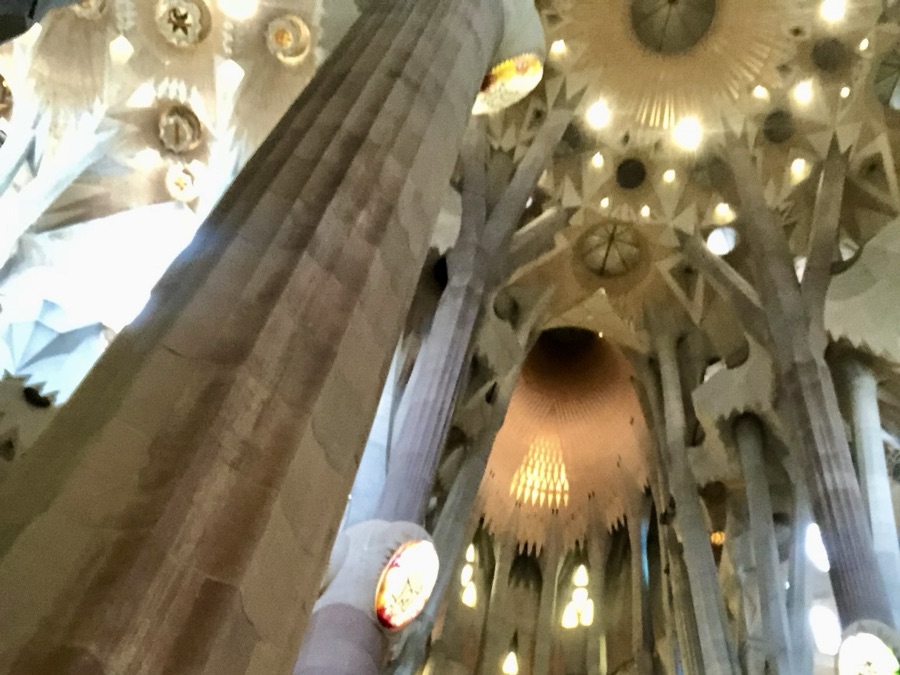
People stood looking upward. So did I.
The columns rose like tree trunks and branched overhead.
Maybe that was enough.
~
On the way out, the guide said the cathedral would open in 2024—one hundred years after Gaudí’s death.
“Will they make it?”
“We hope so.”
His eyes flicked up.
I followed his gaze.
The crane still hung over the cathedral.