
A handwritten sign hung beside the doorway.
PLEASE LEAVE YOUR SHOES ON
The room beyond had polished floors covered in mattresses. Giant string puppets crowded every wall—kings, dancers, camels, horses—some as tall as I was. There were no display cases or labels. Just shelves overflowing with painted faces and tangled strings.
The sign had meant to say, “leave your shoes HERE.”
We laughed, slipped them off, and stepped inside.
Blankets lay folded in one corner.
Someone lived here.
Later that afternoon we wandered through Shilpgram, an open-air museum of traditional villages.
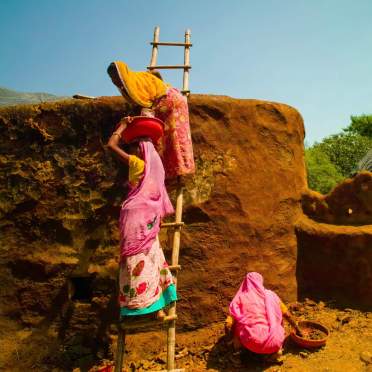
A group of women stood ankle-deep in buckets of wet mud, mixing plaster with their hands. They hoisted the buckets onto their heads, climbed wooden ladders barefoot, and patched the walls of the museum buildings.
Bright pink saris flashed against brown earth.
Visitors drifted between the houses taking photographs while the women kept working.
Inside one hut, blankets were stacked beside the wall.
The room smelled of urine.
Someone lived here too.
That evening we returned to Bagore ki Haveli.
The puppets from the quiet room upstairs came alive beneath the stage lights. Their heads flew into the air and snapped back onto their bodies as the audience applauded. Musicians played. Dancers spun.
Hundreds of people squeezed shoulder to shoulder onto wooden benches inside the old mansion. Even darkness could not hide its crumbling plaster and flaking paint.
The mansion grew quiet again.
Somewhere upstairs, beyond the puppet room, the folded blankets were still waiting.
~
The next morning, we journeyed to the bus station.
When the show ended, the crowd spilled into the courtyard and disappeared into the streets of Udaipur.
The conductor wore a cowboy hat and sported a handlebar mustache below his aviator sunglasses.
Even before climbing aboard, he’d taken special interest in Dani and me.
Making sure we found the right bus among the parking lot.
Making sure we bought the right tickets to Ranakpur.
Now, that we were moving, he caught Dani’s eye and pointed toward the front of the bus.
The light was different up there. Softer.
She looked at me for approval.
I nodded.
“Go.”
Dani squeezed past knees and sacks of grain until she disappeared beside the driver.
When I finally caught sight of her again, she sat cross-legged on a pile of silk cushions spread across the engine cover, smiling as though she’d been invited into someone’s living room.
Scarves hung across the windshield to block the sun. Red, green, and gold cloth turned the cab into stained-glass.
Dust drifted through the open windows.
The driver rested one hand on an enormous steering wheel while the conductor leaned out the open door, shouting at each stop before swinging back aboard without ever slowing the bus.
Between them sat my wife.
I stood in the aisle.
The road narrowed as we climbed into the hills.
Every blind corner seemed to contain a truck, goats, or gray langurs.
After a while, I stopped looking through the windshield.
When seats opened beside Dani, I moved forward.
She waved at me through a part in the curtains and scarves.
Men climbed aboard carrying sacks of grain, bundles of hay, and dented metal buckets.
Some passengers spread their bags across empty seats rather than let the farmers sit beside them.
The conductor quietly gathered the bags without asking, stacked them overhead, and waved the newcomers into the empty places.
Nobody argued with him.
Later, a wasp wandered in through an open window.
Its body glowed iridescent green.
Dani ducked as it circled her head.
The conductor watched for a moment, slid his window farther open, and swatted the insect cleanly back into the forest with the flat of his hand.
He turned, smiled once, and faced forward again.
Three hours after leaving Udaipur, the conductor rolled his window down again. This time, he slapped the side of the bus.
“Ranakpur!”
Dani climbed back to the main compartment, and together, we stepped into the dust.
The bus pulled away almost immediately, its scarves still glowing in the windshield until it disappeared around the next bend.