
Dal Lake reflected the snow-dusted Himalayas.
Houseboats lined one shore shoulder to shoulder, while hand-rowed shikaras drifted between them.
The streets beyond the water felt quiet, with broad sidewalks, orderly traffic, and space to breathe.
Our jeep driver had found us the boat and sent us across the lake to look for a room. It’s lacquered cedar sides were polished to a shine, and pillows and cushions were arranged along the seats. The boatman worked his oar through the water, steering between the moored houseboats.
A man paddled alongside us, holding out packets of spices. He called over the bouw.
“Tea, sir? Saffron?”
I waved my hand and he receded.
Another boat.
“Marijuana?”
In a quieter voice.
“Cold beer? I can get.”
Still we rowed.
Water lilies and lotus flowers spread across the lake. Beyond them, the Himalayas reflected in the still water.
At last we reached the other shore, stopping at one houseboat, then another.
Some had elaborate wooden balconies and carved facades. Others were less impressive.
By the fifth or sixth, we found the S. Shabash. Its carvings covered nearly every surface, inside and out.
The proprietor showed us around.
“Means the good job. S Sabash good boat.”
He beamed and pointed to a photo on the wall.
“Charlton Heston stayed here.”
“How much?”
He named a number.
“Fair price. Fair price.”
I did the math: fifty-four dollars a night.
I looked at my brother. Then we climbed back into the shikara and pushed away from the houseboat.
A few minutes later, the boatman turned around.
The proprietor stood against the railings shouting another price.
We grabbed our bags.
~
The next morning, I sat on the deck of my houseboat and watched the boats slide past. The proprietor had called one for me an hour earlier.
When a boat finally pulled alongside, I grabbed my pack and stepped aboard.
A hand reached out and stopped me.
“Not that one.”
He waved me back to the deck.
“That one is mine. Yours is coming.”
I climbed out again and waited. Another half hour passed.
When my shikara arrived, the paddler ferried me across the lake and named a fare five times higher than the one in my guidebook.
I laughed.
He didn’t. Then, he called over his manager.
The manager turned out to be my houseboat proprietor. He listened, nodded, and repeated the same price.
This time, I paid.
Across the street, a line of auto-rickshaws waited beside the road. The Mughal Gardens were marked six kilometers away on my map.
“Twenty-five kilometers,” the first driver said. Then he named a price, again five times higher than I expected.
The second driver agreed.
So did the third.
I unfolded the map and pointed.
They shook their heads. Wrong map. Then, one of them called over a man who spoke better English.
It was the houseboat proprietor again.
He frowned at my map, reached behind a telephone pole, and produced a stained clipboard. A sheet of paper listed the official fares to the gardens, neatly typed in English.
The price matched what the drivers wanted.
I looked from the clipboard to the proprietor.
He looked back.
I folded my map and walked away.
A mile down the road I found another taxi stand. This time, the fare made sense.
I got in before anyone could change their mind.
~
The taxi climbed away from Dal Lake toward the foothills. Soon the city disappeared behind rows of poplars and chinar trees.
I spent the afternoon wandering from one Mughal garden to the next.
Water spilled from terrace to terrace in long stone channels. Fountains hissed in the sunlight. Behind them, the Himalayas rose so abruptly they seemed to begin where the gardens ended.
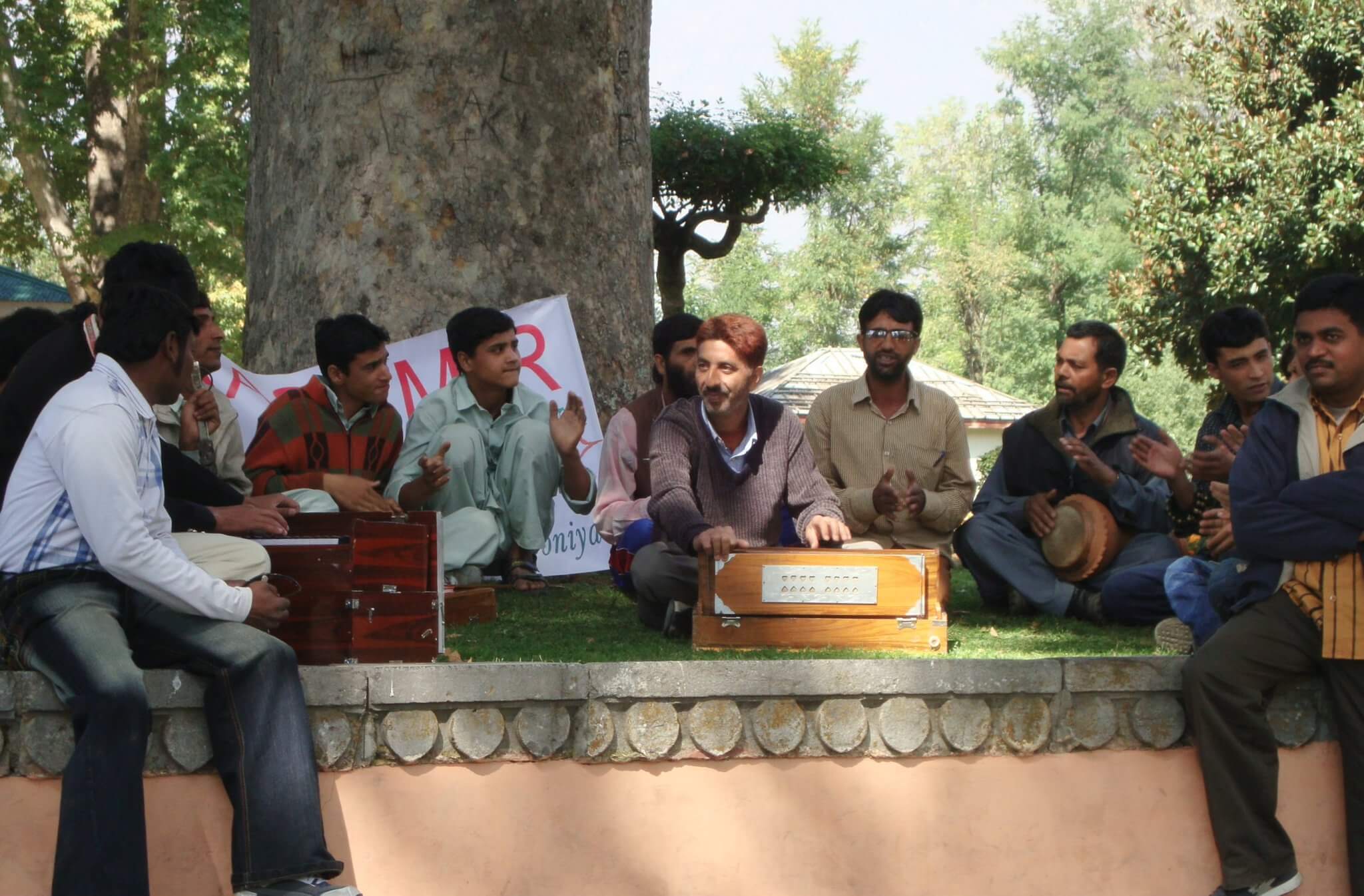
Families sat in the grass while musicians played beneath colorful tents.
I stopped for a few minutes before moving on.
People kept approaching me.
“Hello!”
“Where are you from?”
One family handed me their camera and asked me to take their picture. Another wanted one with me standing beside them.
After the morning I’d had, every greeting felt like the beginning of another negotiation.
It wasn’t.
They smiled, took pictures, thanked me, and wandered away.
~
Later I asked a group of Kashmiri girls if I could photograph them instead. They wore bright blues, emerald greens, and golds—patterned scarves falling loosely around their shoulders.
The girls blushed then laughed and shook their heads.
Then one pointed at another.
“Her!”
The second girl stepped forward, then squealed and ran.
A third volunteered her friend instead.
I never took a single photograph.